


Optical Coherence Tomography (OCT) in Santa Fe: How We Detect Macular Degeneration Years Early
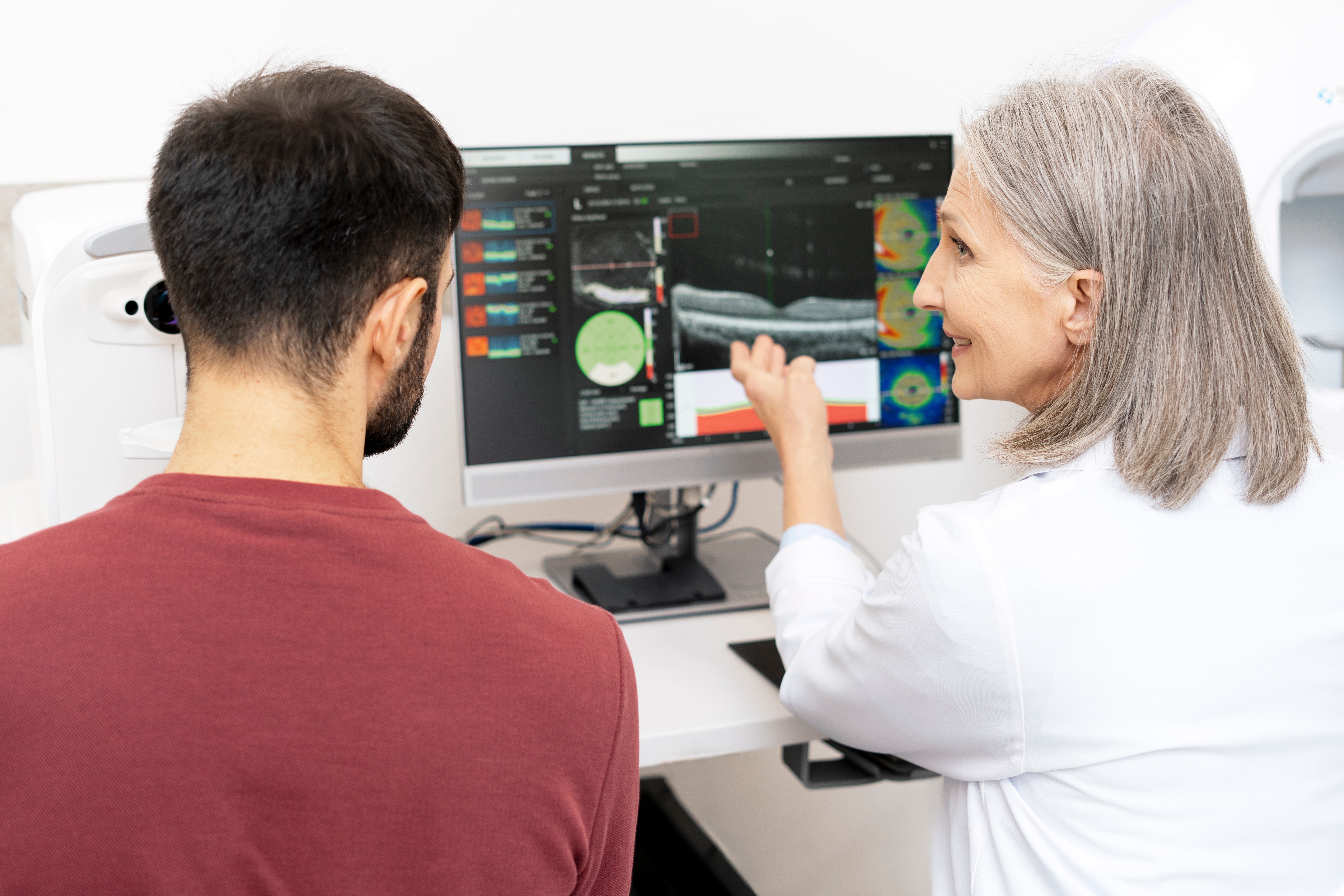
Macular degeneration can begin changing the retina before you notice significant problems with your vision. That is why advanced retinal imaging has become an important part of detecting and monitoring age-related macular degeneration, or AMD.
At Texas State Optical in Santa Fe, we use Optical Coherence Tomography, commonly called OCT, to examine the retina in remarkable detail. This non-invasive technology can reveal subtle structural changes in the macula before they cause obvious vision loss, giving us valuable information about your retinal health.
What Is Optical Coherence Tomography?
OCT is an advanced imaging test that uses light waves to create detailed cross-sectional images of the retina.
The retina contains several thin layers of tissue at the back of the eye. At its center is the macula, which is responsible for the sharp central vision you use for reading, driving, recognizing faces, and seeing fine details.
An OCT scan allows us to examine these retinal layers individually rather than viewing only the surface. This makes it useful for identifying small changes that may be difficult for a patient to notice on their own.
What Happens During an OCT Scan?
OCT imaging is quick, comfortable, and does not involve radiation. During the test, you look into the imaging device while it captures detailed scans of the back of your eye.
The images can help us evaluate:
- The thickness and structure of the macula
- Changes within individual retinal layers
- Fluid or swelling within or beneath the retina
- Areas of retinal thinning or disruption
- Changes associated with macular degeneration
- Progression compared with previous OCT scans
Because the images are digital, they can also provide a useful baseline for future Santa Fe eye exams.
How OCT Helps Detect Macular Degeneration Early
Age-related macular degeneration affects the macula and can occur in dry or wet forms.
Early AMD may cause few or no noticeable symptoms. A patient can still read an eye chart well while subtle changes are already developing in the retina.
OCT allows your eye doctor to look for structural abnormalities in and around the macula before significant central vision loss occurs. When imaging is repeated over time, even small changes can be compared with previous scans.
This does not mean OCT can predict exactly when someone will develop AMD. Instead, it gives us a detailed way to identify and monitor retinal changes earlier than waiting for symptoms alone.
Dry vs. Wet Macular Degeneration
Dry AMD is the more common form and usually progresses gradually. Your eye doctor may monitor retinal changes, drusen deposits, and areas of thinning over time.
Wet AMD is less common but can progress more quickly. Abnormal blood vessels can develop beneath the retina and leak fluid or blood. OCT is particularly valuable because it can show fluid accumulation and other structural changes that may require prompt referral or treatment.
Sudden distortion, a new central blind spot, or straight lines appearing wavy should always be evaluated promptly.
Who Should Be Monitored Closely?
Risk for AMD increases with age, particularly after age 50. Family history, smoking, cardiovascular health, and other factors may also influence risk.
If macular degeneration runs in your family, regular comprehensive eye exams become especially important. Even if your vision still feels normal, retinal imaging can help us establish a baseline and watch for changes over time.
OCT Is One Part of a Complete Eye Exam
OCT provides highly detailed information, but it does not replace the rest of a comprehensive eye examination. Visual acuity testing, retinal evaluation, medical history, and other diagnostic testing may also be necessary depending on your risk factors and findings.
At Texas State Optical in Santa Fe, we use advanced technology alongside a complete clinical evaluation to identify eye disease as early as possible and determine when additional monitoring, treatment, or specialist care may be appropriate.
If you are concerned about macular degeneration or want a closer look at your retinal health, schedule a comprehensive eye exam with Texas State Optical at 13135 Highway 6, Santa Fe, TX 77510, or call (409) 231-6800 to learn more about OCT retinal imaging.


Operating Hours
- Monday Closed
- Tuesday 8:00 AM - 5:30 PM
- Wednesday 8:00 AM - 5:30 PM
- Thursday 8:00 AM - 5:30 PM
- Friday 8:00 AM - 5:30 PM
- Saturday 8:00 AM - 12:00 PM
- Sunday Closed
Contact Us
© 2026 Texas State Optical. All rights Reserved. Accessibility Statement - Privacy Policy - Sitemap
Powered by:
